

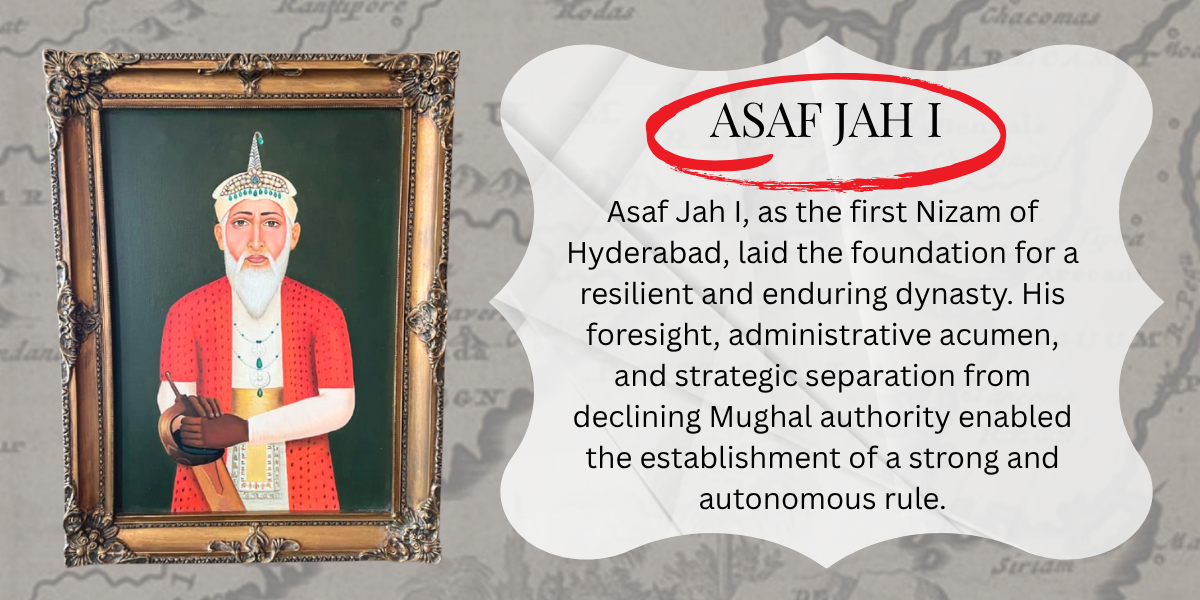
Starting in 1724, Asaf Jah I, earlier known as Mir Qamar-ud-din Khan, laid the foundation for a powerful and largely stable Asaf Jahi dynasty in the Deccan region, particularly in Hyderabad.
AURANGZEB DEATH
The death of Aurangzeb in 1707 revealed just how dependent, the seemingly formidable Mughals were – on one powerful personality, Aurangzeb. Mir Qamar-ud-din Khan later known as Asaf Jah 1, held important positions in the Mughal administration. The declining power of the Muhgal rule, resulted in the Deccan region being neglected.
MOGHULS NEGLECT DECCAN
In 1724, Mir Qamar-ud-din Khan took advantage of the weakening central Mughal authority and asserted his autonomy by defeating Mubariz Khan, the Mughal governor of the Deccan, at the Battle of Shakar Kheda. He then established his seat of power in Hyderabad, becoming the first Nizam of Hyderabad.
Mir Qamar-ud-din Khan would now call himself, Asaf Jah I and was titled the first Nizam of Hyderabad. Important to note that, the Moghuls neglect of the Deccan region, was one of the prime reasons, given by Asaf Jah 1 for taking control of the region. It is therefore no surprise that, as the first Nizam of Hyderabad, had a fairly clear roadmap to develop the Deccan region and improve the living conditions of the people.
NIZAM RULE
Having a clear understanding of the region, Asaf Jah 1 realized that developing infrastructure, setting up an effective administrative framework and taking care of welfare requirements of the people, would require a significant amount of time. The foundation was of prime concern, procedures and processes had to set in place.
Using the administrative skills he had acquired during his long service with the Mughals, Asaf Jah I laid the foundation for a strong and resilient Nizam rule in the Deccan. His effective governance and foresight established a legacy that endured through seven Nizams, with the dynasty ruling Hyderabad continuously until 1948. That was the time when Hyderabad was included within the Indian map.
LAYING THE FOUNDATION
Mentioning a few constructive developments, that Asaf Jah I initiated – the objective was to ensure that the development of Hyderabad and the welfare of its people, always remained in focus. He implemented a merit-based administrative structure. This move was appreciated by his team of advisors and by the people in general. An atmosphere was created where, administration was conducted smoothly and the people, trusted the administration.
The first Nizam gave importance to law and order, revenue collection, and a strong military. He was experienced enough to realize that, the true stability of Hyderabad depended on a united and peaceful internal structure. External aggression could not be avoided and the best that the Nizams could do, would be to remain alert and maintain a strong and motivated military.
REVENUE COLLECTION
Funds were an absolutely necessity to implement various developmental plans for the region. Asaf Jah 1 put an effective revenue collection and audit process into place. Care was taken to ensure that, revenue to the treasury of the Nizams and funds allocated for the development of Hyderabad and various welfare policies for the people – were accurately recorded and utilized.
RELIGIOUS TOLERANCE
The Nizam rule starting with Asaf Jah 1 in 1724 made it clear that, religion would not be used to divide people. The Nizams consistently maintained religious tolerance, employing people based on capability rather than religion. By inculcating a strong sense of religious tolerance among the Nizam rulers, administrators and the people – pressure on law enforcing officers, was considerably reduced.
ASAF JAH 1 LEGACY
His foresight and policies laid the foundation for more than two centuries of Nizam rule—remarkably stable by Indian princely standards—lasting until 1948, when Hyderabad was integrated into the Indian Union.
